Tool Grinding
Drills, end mills and micro rotary tools take their shape from grinding: flute, land, point and shank are produced by the wheel alone. Small tool diameters, high cutting speeds and slender cross-sections leave little room – form accuracy, sharp cutting edges and a reproducible surface are what count.
Process
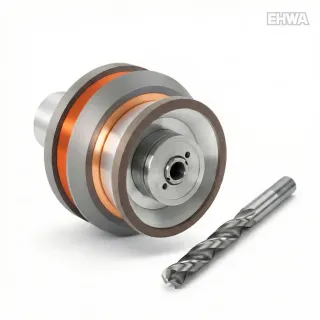
For this EHWA supplies CBN and diamond grinding wheels with matched polyimide and hybrid bonds. They keep the free-cutting behaviour defined and the process stable.
Thermal stability, controlled porosity and adapted grit retention work together here: low grinding forces, edge quality that holds over the tool life, and results that repeat in series and high-volume production.
What the process gains
Longer dressing intervals
Stable profile geometry and higher net running time per shift
Consistent flute and surface quality
Reproducible cutting edge quality over the entire tool life
Reduced thermal load
Lower risk of grinding burn and dimensional deviation at high feed rates
Recommended tools
| Product types | Cylindrical, profile and flute grinding wheels |
|---|---|
| Abrasives | Diamond (carbide, cermet), CBN (HSS, PM steels, high-alloy tool steels) |
| Bonds | Phenolic (PF), polyimide (PI / HT-PI), hybrid (HB) |
| Grit sizes | D46 – D151 · B46 – B151 |
| Dimensions | Ø 75 – 400 mm |
Process example
Flute grinding of solid carbide end mills (Ø 8 mm, 4 flutes) in series production
Goal: Increase tool life with consistent flute geometry and reduced thermal load
| Material | Solid carbide, K30 – K40 |
|---|---|
| Process | Deep flute grinding (full cut), wet grinding |
| Tool length | 60 mm |
| Grinding wheel diameter | 150 mm (profile wheel) |
| Peripheral speed | 45 – 55 m/s |
| Feed rate | 80 – 120 mm/min |
| Infeed | 2.0 – 2.5 mm radial (over several strokes) |
| Dressing interval | 120 – 150 tools |
Result
- Longer dressing intervals, higher machine availability
- Consistent flute width (±0.01 mm), reproducible tool performance
- Reduced grinding forces, lower thermal influence on the surface zone
- Stable surface quality (Ra 0.4 – 0.6 µm) over the entire tool life
Figures from an approved customer process. Tools are always engineered around the machine, workpiece, and process of the individual case – these figures are evidence, not a guarantee.